
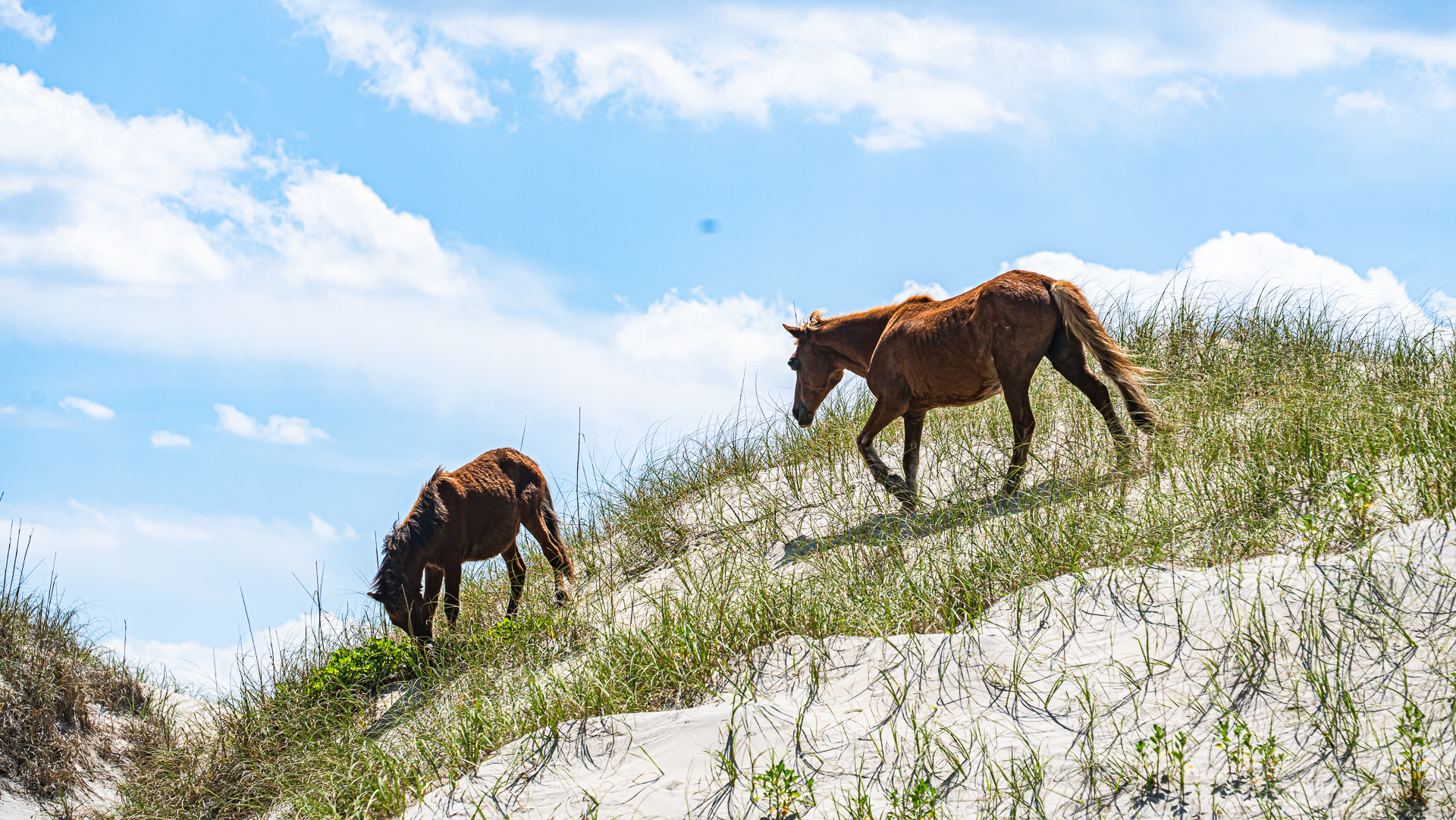
You’ve probably heard about the Outer Banks wild horses – or seen the signs while driving in, warning to keep your distance from the herds. You might have even seen a few of them on your visits to the 4x4 area in Corolla, or when you’ve traveled down to Bodie Island, or further down to Ocracoke Island.
These wild horses may look like Spanish mustangs, but they’re actually called Banker horses: a breed of horses descended from the mustangs. And technically, they are considered “feral,” not wild, as they are the offspring of once-domesticated animals.
But how did Spanish horses end up on a North American island chain? Researcher W.B. Blythe suggests that they are survivors of shipwrecks from the Graveyard of the Atlantic has claimed, but according to National Geographic, the horses are most likely brought by early settlers to the islands, where they now live off the saltmarsh grasses, and dig holes in the ground with their hooves to gain access to pools of fresh water, and when the grass or fresh water becomes scarcer, they’ll swim to nearby islands for more resources.
There’s actually a bit of controversy surrounding these animals – as they are technically an invasive species, and their movement tramples native plants and animals, but because of their historical significance to the area, the National Park Service has maintained the population, ensuring that it continues to thrive without overgrazing in the wilds of the Outer Banks.
While the National Park Service is ultimately charged with the conservation of the Outer Banks feral horses, there are local organizations that work closely to help protect the horses from humans and other threats to the population.
The Corolla Wild Horse Fund monitors 7,544 acres of land where the horses roam, and operates a 31-acre farm on the Currituck mainland in Grandy, where Banker horses in need of rescue or removal from the wild are brought to be cared for. 20 horses live on the farm, and the Corolla Wild Horse Fund allows for sponsorships for the horses under their care, covering their medical treatment, feed, essential upkeep of our barns and pastures, and other costs.
They also offer volunteer opportunities, and in keeping with the Outer Banks Blue Promise, we highly recommend donating your time to the Corolla Wild Horse Fund! They are always looking for help, so if you have a free day, ask them how you can help! Unfortunately, these volunteer opportunities don’t usually get you up close and personal with the horses (those positions require special training), but if you want to see the horses up close and personal, on Wednesdays the organization hosts Mustang Mornings at the farm, known as the Betsy Dowdy Equine Center. From 10 a.m. to 2 p.m., the Corolla Wild Horse Fund conducts walking tours, screens a documentary on the Banker mustangs, the culture, and lifestyle of the islands, and after the screening the Director of Herd Management is available to answer questions. While Mustang Mornings are free, a donation of $10 per vehicle is appreciated.
Banker Horses in the Wild
It is possible to take tours in Corolla to see the Banker horses in the wild. Wild Horse Adventure Tours and Corolla Wild Horse Tours are two off-roading companies that will take 13 -15 people in open-air vehicles up into the 4x4 area of Corolla and beyond to see the herd of around 100 horses that roam free. For more information, check out our Things to Do article on wild horse tours!
If you do see the wild horses while visiting the Outer Banks, remember: stay 50 feet from them at all times! There is a county ordinance that makes it illegal to approach the horses any closer than that. Even if they approach you, it is your duty to move away from them. Do not feed the horses either – the same genetic changes that allow them to survive on the native plants of the Outer Banks make them unable to tolerate even foods that domesticated horses enjoy (such as apples and carrots).
Vacationers have reported seeing the horses when they wander through the neighborhoods and even into the backyards of their Corolla vacation rentals, so keep an eye out, but keep your distance, and respect the beautiful nature of the Outer Banks!